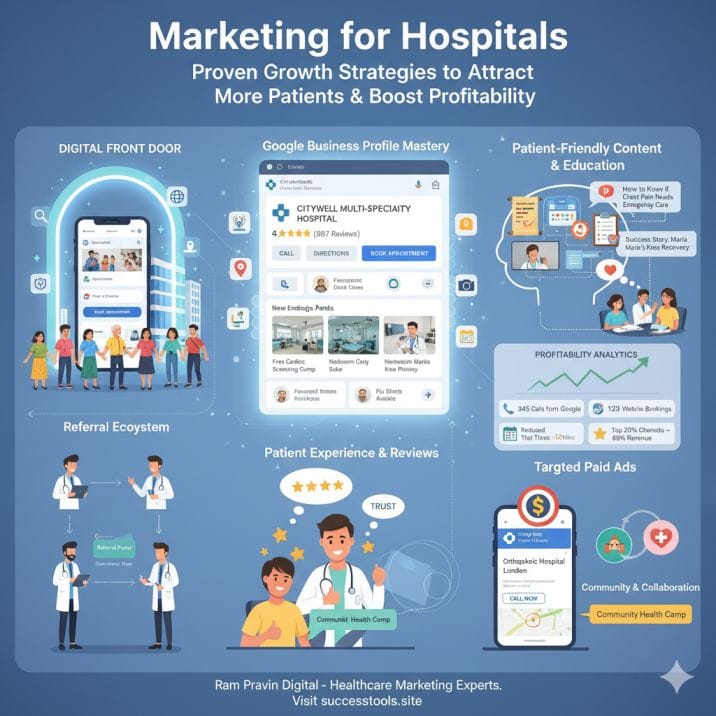
If there’s one platform that directly impacts your Hospital’s patient inflow, it’s Google Business Profile (GBP) — previously known as Google My Business.
If you run a clinic, specialty center, or hospital, you already know that excellence in care doesn’t automatically translate into patient flow or profitability. Many hospitals deliver world-class treatment, yet struggle to attract steady patient inquiries or fill their beds.
That’s where marketing for hospitals comes in — not as a sales gimmick, but as a sustainable growth engine. The right marketing strategy helps you reach more patients, build reputation, and make every department profitable without depending only on referrals or seasonal demand.
This guide explores seven practical, data-driven strategies that have helped hospitals across the world increase revenue, attract quality patients, and build stronger community trust.
No jargon, no complicated theories — just doctor-friendly, business-smart insights you can apply immediately.
1. Master Your Google Business Profile (Google My Business)
For hospitals, this free tool is the single most powerful local visibility driver. It determines whether your hospital shows up when someone nearby searches for:
- “hospital near me”
- “best pediatric clinic in [city]”
- “24-hour emergency care [location]”
- “cardiologist nearby”
Why it matters:
- Profiles with complete information get 7x more clicks than incomplete ones.
- Verified listings appear in the top “Local 3-Pack” — the three results Google highlights on maps for local searches.
- Patients often make decisions without even visiting your website — they look at your photos, reviews, and call directly from the profile.
How to optimise Google Business Profile for your Hospital:
- Claim and verify your profile using your hospital’s name and accurate business category (e.g., Multi-Specialty Hospital, Dental Clinic, Maternity Centre).
- Add complete details: Address, hours, emergency numbers, specialties, website, and booking links.
- Upload quality visuals: Photos of reception areas, operation theaters, wards, and doctors (with consent). Videos of your facility or introductions from your doctors perform extremely well.
- Use posts weekly: Share updates such as “Free Cardiac Screening Camp on 15th Nov,” “New Endoscopy Suite Now Open,” or “Flu Shots Available.”
- Encourage patient reviews: Politely ask happy patients to share their experience. Respond to every review — both positive and negative. It signals care and professionalism.
- Enable messaging: Let patients text you directly from Google. Quick replies often turn inquiries into appointments.
- Track performance: In your GBP dashboard, monitor “calls,” “website visits,” and “direction requests” — these metrics show what’s driving inquiries.
Doctor-friendly takeaway:
Your Google Business Profile is your new outpatient reception desk — only it works 24/7. When optimized properly, it can bring a steady stream of local patients without paying for ads.
2. Build the “Digital Front Door” That Brings Patients In
Before patients step into your hospital, they step into Google.
Your website and your online listings act as your digital front door — often the first impression a potential patient gets. According to healthcare consumer data, over 75% of patients research a hospital online before booking an appointment.
What to do:
- Audit your website: Is it fast, mobile-friendly, and easy to navigate? Does it clearly explain your services, specialties, and contact details?
- Use the right keywords: Include location-based and specialty-based terms like “orthopedic hospital in London”, “cardiac specialist in Chicago”, “women’s health clinic near me.”
- Show your expertise visually: Add real photos of your facility, team, and patient-care environment — not stock images. Patients trust what looks real.
- Simplify contact options: Use visible “Book Appointment” or “Call Now” buttons on every page.
When your website makes information easy to find, it improves both patient conversion and trust — two critical profitability levers for hospitals.
3. Use Patient-Friendly Content That Builds Trust (Not Hype)
Patients search for answers, not ads. Your content should reflect that.
Doctors who explain, educate, and empathize online build credibility faster than those who simply promote.
Ideas that work:
- Write articles such as:
- “How to Know If Chest Pain Needs Emergency Care”
- “Preparing for Knee Replacement: A Simple Guide for Patients”
- “How to Choose the Right Fertility Specialist”
- Record short 1-minute explainer videos answering common patient questions.
- Share anonymized success stories (with consent).
- Create downloadable checklists — “Before Your Surgery,” “Diet After Discharge,” “Newborn Care Basics.”
Each piece of content you publish acts as a trust signal and an SEO magnet — helping you rank for long-tail searches like “best IVF hospital near me” or “recovery time after cataract surgery.”
Bonus Tip:
Repurpose every piece of content — post it on your Google Business Profile, share on Facebook or LinkedIn, and send it via WhatsApp to existing patients.
This multiplies reach without extra effort.
4. Track Data to Find What Actually Brings Profits
Marketing without tracking is like prescribing medicine without diagnosis.
Use simple analytics tools to understand which activities are driving results.
What to measure:
- Google Business Profile insights: Calls, messages, direction requests.
- Website analytics: Which pages lead to appointment bookings?
- Ad conversion data: Which campaigns brought paying patients?
- Referral tracking: Which referring doctors or websites send patients who convert?
How it increases profitability:
When you identify the top 20% of sources that bring 80% of revenue, you can double down there and stop wasting time or money elsewhere.
For example, if 60% of your inquiries come from your Google listing, invest more effort in reviews, photos, and GBP posts — not newspaper ads.
5. Strengthen Referral Ecosystems and Doctor Relationships
Hospital profitability depends not only on new patients, but on consistent referrals from other physicians and clinics.
Ways to nurture your referral network:
- Maintain direct communication with referring doctors. Share brief patient progress updates (where HIPAA or GDPR allows).
- Host quarterly webinars or in-person CME (Continuing Medical Education) sessions.
- Create a referral-friendly portal where doctors can upload referrals easily and receive feedback.
- Acknowledge loyal referrers publicly (with permission) in newsletters or events.
Building professional goodwill is a long-term growth engine — one that even digital ads can’t replace.
6. Make Patient Experience Your Best Marketing Channel
Every satisfied patient is a marketer in disguise.
Positive experiences fuel online reviews, word-of-mouth, and repeat visits — all of which directly impact profitability.
Quick wins:
- Reduce wait times and improve communication.
- Train your front-desk staff on empathy and responsiveness.
- Collect feedback immediately after discharge.
- Showcase improvements: e.g., “Our average waiting time is now 12 minutes shorter than last year.”
When your hospital consistently delivers satisfaction, your marketing costs go down — because happy patients bring new ones for free.
7. Use Paid Ads & Geo-Targeting Only Where It Profits
Digital ads are powerful when done with precision. They shouldn’t be about visibility alone, but about return on spend.
How to make paid ads profitable:
- Use Google Ads only for high-margin services (orthopedic surgery, fertility treatments, advanced diagnostics).
- Geo-target your city or region to avoid wasting money on irrelevant clicks.
- Use call tracking — know exactly which ad generated which call or booking.
- Link every ad to a clear landing page (not your homepage) with a call button and form.
When combined with your Google Business Profile, paid ads can push your listing to the top for crucial searches like “emergency hospital open now” or “best neurologist near me.”
8. Collaborate and Host Awareness Events
Partnership marketing adds both reach and credibility.
- Collaborate with schools, corporates, and NGOs for health camps.
- Conduct webinars for patient education.
- Host “Hospital Open Days” where families can tour your facility.
- Partner with fitness centers, diagnostic labs, or wellness influencers for cross-promotions.
These activities humanize your brand and often generate local press coverage — a bonus for SEO and reputation.
Bringing It All Together: A Profit-Focused Roadmap
Here’s a simple 6-month plan to align your marketing with profitability:
| Focus | Expected Result |
|---|---|
| Optimise website & Google Business Profile | Increase visibility and calls |
| Publish patient-friendly content (blogs, videos) | Build trust, better ranking |
| Start collecting reviews & feedback | Boost local SEO & conversions |
| Run small geo-targeted ad campaign | Test ROI on high-value services |
| Host community health event | Brand awareness & new patient leads |
| Analyse data and double down on top-performing channels | Sustainable growth & profitability |
Final Thoughts: Marketing as a Profit Lever, Not an Expense
Marketing for hospitals isn’t about showing off — it’s about making your excellence visible to the people who need it most.
Doctors who embrace marketing as a patient-education and visibility tool see consistent revenue growth and higher utilisation of their facilities.
When your hospital ranks higher on Google, earns strong reviews, nurtures referrers, and delivers a memorable patient experience — profitability becomes the natural outcome.
Start small: optimise your Google Business Profile, share helpful content, and respond to every review.
You’ll be amazed how quickly these “simple” actions turn into real patient volume and bottom-line growth.
About Ram Pravin Digital
At Ram Pravin Digital, we help clinics, specialty hospitals, and multi-location healthcare providers across the US & UK attract quality patients, grow profitability, and dominate local search results through strategic digital marketing.